
Different Career Paths for Engineers in the AI Era
July 2, 2026
Over the past few days, Boris Cherny, the creator of Claude Code, shared an observation from the Claude Code team: as AI advances, different functions are gradually blending together. Instead of the old split between engineering, product, and design, team members increasingly fall into five different archetypes.
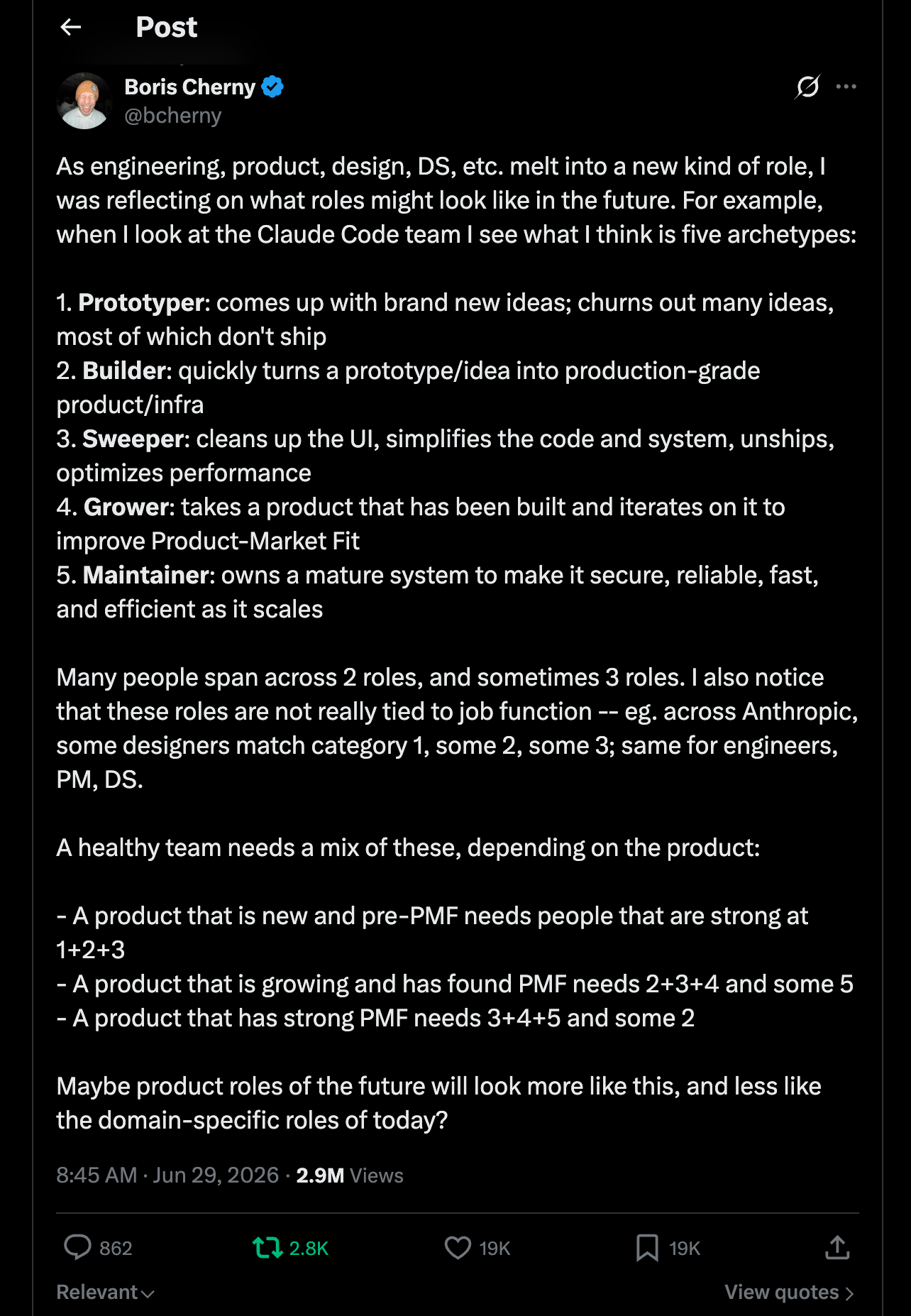
Those archetypes are:
- Prototyper: Comes up with new ideas and quickly produces many possibilities, most of which may never ship
- Builder: Turns a prototype or idea into a real product or piece of infrastructure that can go live
- Sweeper: Cleans up interfaces, simplifies code and systems, removes things that should not exist, and improves performance
- Grower: Takes over a product that already exists and keeps iterating until it gets closer to product-market fit
- Maintainer: Owns a mature system and keeps it secure, reliable, fast, and efficient as it scales
He also mentioned that many people span two of these roles, and sometimes even three. At Anthropic, some designers look more like type 1, some like type 2, and others like type 3.
He also argued that a healthy team needs different kinds of people depending on the product stage. For example, a very new product that has not yet found product-market fit needs people who are strong in types 1, 2, and 3. A growing product that has found PMF needs types 2, 3, and 4, plus some type 5 people. A product with very strong PMF needs types 3, 4, and 5, plus some type 2 people.
When we read the post, we thought this classification was useful. It breaks down what different teams need from the perspective of problem solving. Even when everyone has the same title, "engineer," they may be doing very different work. Some people turn vague ideas into prototypes. Some turn prototypes into production products. Some clean up messy systems. Some help products find a market. Some keep mature systems stable.
From a software team's perspective, this gives teams a language for discussing what stage they are in and what kind of people they are missing. Do they need engineers who lean more toward prototyping, or engineers who can build long-term systems at large scale?
But from an individual perspective, we think this kind of classification requires caution. Once there are archetypes, many people may start to believe they belong to one type of engineer and then lock themselves into that identity, limiting their own career development.
In the real world, if a team grows from an early startup into a mature product, or even a large-scale product, an engineer's role has to keep evolving along the way. Even within the same team, the scale will not stay in the same stage forever, and the problems will not always look the same. The engineers we admire most are usually the ones who can evolve their role as the product grows.
So use this kind of classification to reflect on what your team needs, but as the team keeps developing, do not let your original role limit you. Aim to become the kind of engineer who can create value at every stage.