
Use ChatGPT to Improve Your English Resume: Software Engineer Edition
March 15, 2023
After publishing Software Engineer Resume Guide, I received many requests for resume review help. But because of work capacity, I could not support everyone directly.
That led to a practical idea: AI tools like ChatGPT have become strong enough to help with resume editing, so why not document a repeatable workflow readers can run themselves? It is faster and can save money compared to paid editing services.
I rely heavily on tools like GitHub Copilot and ChatGPT in daily work. In my experience, the biggest unlock is asking better questions. This article focuses on exact prompts and iteration steps you can use to get better resume output.
To test whether this works across different professions, I tried two domains I know: frontend engineering and UI/UX design. This article uses the frontend case. If you want the UI/UX version, see Use ChatGPT to Improve Your English Resume: UI/UX Edition.
Prompt quality matters
The original examples were in Chinese. If you are applying to global companies, you will likely need an English resume. The process below helps you convert rough Chinese bullets into polished English bullets.
- Translate your Chinese bullets to English first (for example with Google Translate).
- Paste the translated bullets into ChatGPT and ask:
Critique the following experience on a resume. - After feedback, ask:
Rewrite the above resume bullet points using the suggestions you provided. - Then refine using resume principles (strong action verbs, qualitative + quantitative evidence). Prompts like
Polish the above with strong action verbsandPolish the above quantitatively and qualitativelyare useful. - If the result becomes too long, ask:
Make it more concise.
Example: Frontend Engineering
Using the process above, we start with these original points:
- Built an online editor using React and Tailwind CSS.
- Implemented core web features and responsive layout.
- Added server-side rendering and OG meta tags to improve SEO.
- Implemented drag-and-drop editing with Fabric.js.
- Integrated complex reducers with Redux and used immer.js for state updates.
The initial translation may be rough, but that is fine because ChatGPT will help with refinement.

Next, ask ChatGPT for critique using Critique the following experience on a resume. The feedback usually highlights missing context, scope, and measurable impact.
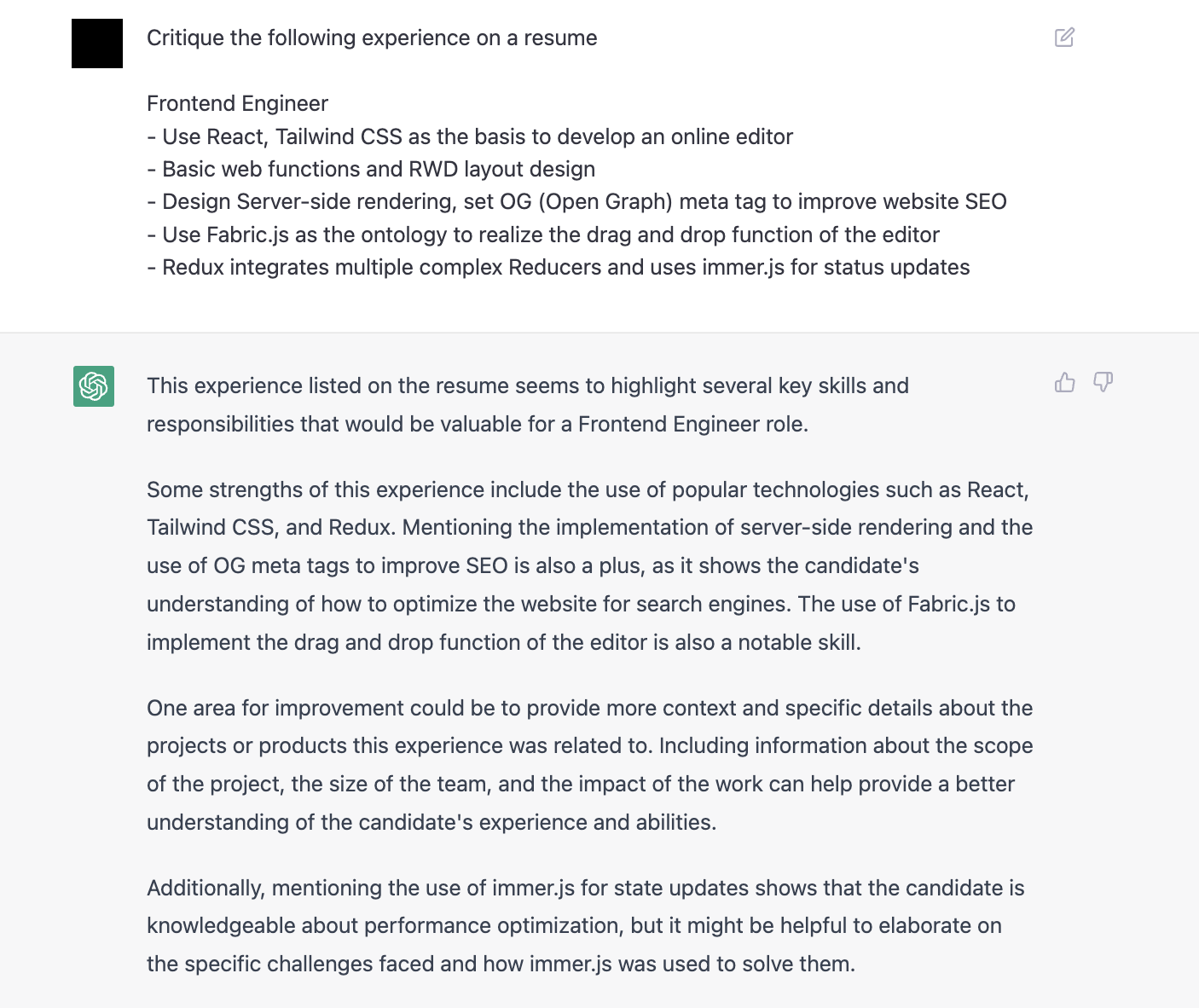
Then ask it to rewrite based on its own suggestions.

The first rewrite is usually better but still light on evidence. Ask it to add qualitative and quantitative support using Polish the above quantitatively and qualitatively.
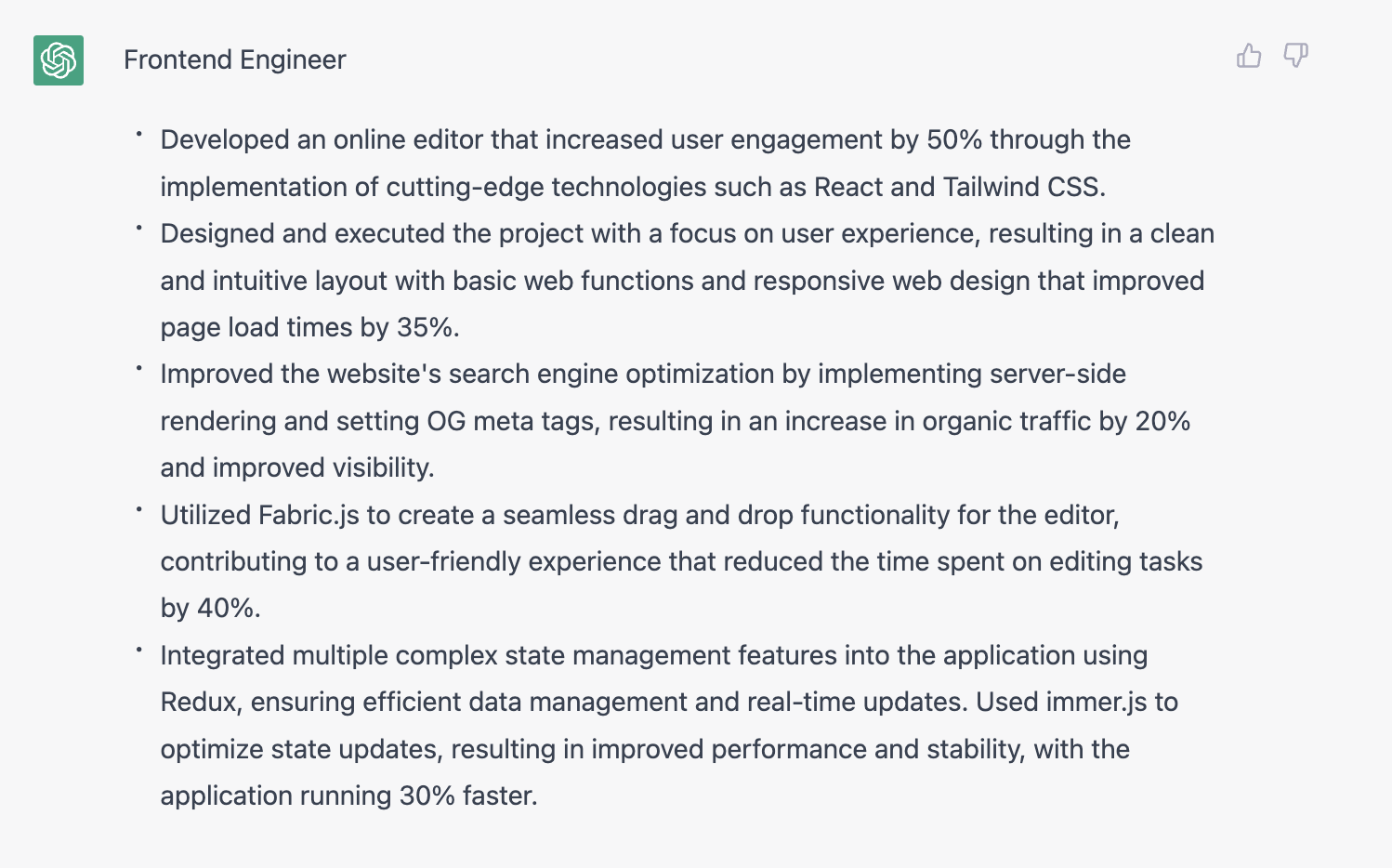
If the result is too long, ask Make it more concise.

A balanced final version could look like this:
- Developed a feature-rich online editor using React and Tailwind CSS, boosting user engagement by 50%.
- Designed and executed the project with strong UX focus, resulting in a clean and intuitive responsive interface.
- Improved SEO with server-side rendering and OG meta tags, increasing organic traffic by 20%.
- Utilized Fabric.js to build seamless drag-and-drop interactions, reducing average editing time by 40%.
- Integrated complex state management with Redux and immer.js, significantly improving maintainability.
Compared to the original Chinese bullets, this version has stronger action verbs and clearer impact framing.
Wrap-up
From this example, you can see that Google Translate + ChatGPT can produce resume wording that feels close to professional editing output.
One critical reminder: do not blindly use AI-invented claims. If ChatGPT adds numbers, replace them with your real metrics. Accuracy and honesty still matter more than polished wording.
Also, even if two candidates use similarly strong writing, the one with stronger real outcomes (for example, larger production scale) will usually have an advantage.
If you are curious whether this method works for other roles, check the UI/UX version here: Use ChatGPT to Improve Your English Resume: UI/UX Edition.